Courtesy and Copyright © Duncan Grisby 2006
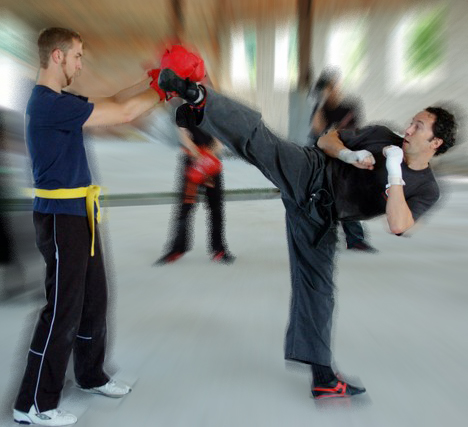
Different schools and styles of martial arts teach the hook kick (also called reversed round kick) in different ways. Main differences manifest essentially in the way the movement originates, how the kicking leg is moving during the kick and what part of the foot hits the target that can be the hill or the sole/ball of the foot.
When I teach how to perform a hook kick, I first clarify that to maximise performance the leg should follow a whipping movement to ensure maximum acceleration of the foot toward the target.
I also suggest to always hit with the ball of the foot. Here are for 5 good reasons both physiological and in terms of pure performance for doing that rather than the (side of the) hill, keeping the foot at 90° to the ankle:
- better reach: having the foot extended it increases your range by nearly the full length of your foot ensuring you will hit, from the same position, targets that would not be reachable if you bend your foot.
- stronger impact: if the angular speed of the leg moving is constant having a longer weapon (by the length of the foot) increases the speed of the foot itself, build up a higher momentum and delivers a stronger kick..
- safer for you: the Achilles’ tendon is a weak point and if you squash it against a skull it will hurt your foot to the point you might not be able of walking for some time. Even if the impact is not straight on the Achilles’ tendon it can still hit the many nerves that are exposed both on the internal and external part of the hill, moving toward the ankle. The ball of the foot is very well padded and can bear much stronger impact than the edge of the hill.
- improve flexibility: with the foot fully extended the natual flexibility of the leg is highly helped; to the contrary trying to extend a leg while the tibial (shin) muscles are tensed in order to keep the ankle at 90° will have some groups of muscles that are fighting against the direction of your kick getting the muscles behind the leg less prone to extend
- faster: if all muscles involved in the movement are pushing in the same direction and the others are simply relaxed the overall speed will be improved.
In terms of pure power the hook kick is not to be considered at the top of the scale where round kick and other forward kicks can develop much stronger impact. Things change when spinning backward where the whole spinning momentum adds up to the actual mechanical movement of the kick itself.
Extra information about the hook kick can be found by checking this post.
As usual, any comment is highly appreciated.