The martial artist vs. the gig fighter: why consistency beats the “cramming” culture

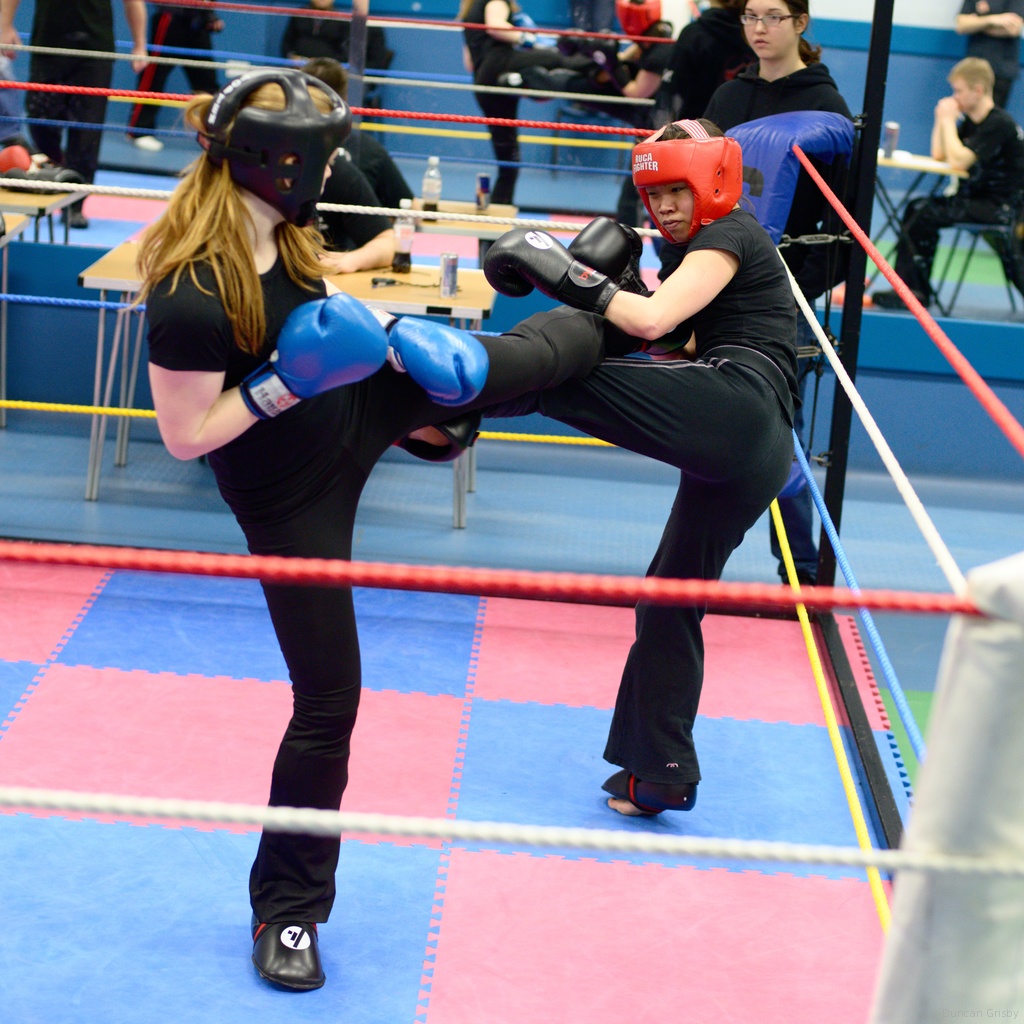
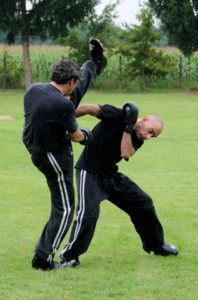
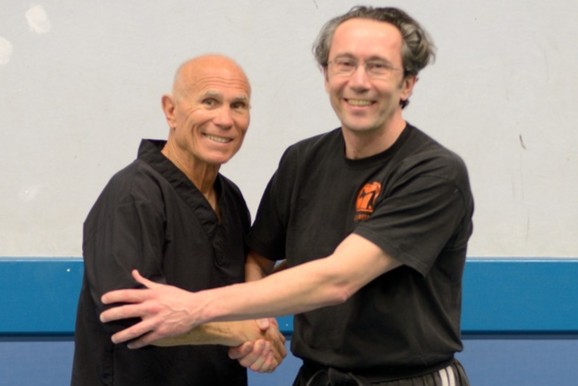
Image Courtesy and Copyright Duncan Grisby

Image Courtesy and Copyright Duncan Grisby

In the modern era of combat sports, we’ve witnessed the rise of the “training camp”—an intense, multi-week sprint designed to peak an athlete for a specific date. While this works for the elite 1% of professional fighters, it has birthed a “gig culture” in local gyms and university clubs. This shift away from consistent, lifelong practice toward a “project-based” approach isn’t just a change in training style; it’s a fundamental misunderstanding of what it means to be a martial artist.

The “old school” blueprint: training for longevity

The “old school” philosophy isn’t about being soft; it’s about being sustainable. The goal is to train consistently and hard, but always with enough reserve that you aren’t “broken.” Take, for example, the legendary Bill “Superfoot” Wallace. Even in his 80s, Wallace remains incredibly fit, flexible, and capable of demonstrating while teaching, which he still does weekly. He didn’t achieve this through sporadic bursts of violence followed by months of sedentary living. He achieved it through a steady, rhythmic relationship with his craft. Your goal should be “ready to go” at any moment, rather than spending six weeks “getting ready” to start training.

The Cambridge trap: cramming for the canvas

A fascinating case study in this “gig culture” can be found in high-pressure academic environments, such as the University of Cambridge Kickboxing team. Students there are masters of the “academic sprint”—absorbing thousands of pages of complex information in a short window to pass gruelling exams. Naturally, many try to apply this same logic to fighting:

  1. The approach: treat the fight like a final exam.
  2. The method: train at 200% intensity for a few weeks, neglecting rest and foundational skill-building.
  3. The results: a crash-and-burn cycle, inadequacy and defeat more often than not.

The fatal flaw here is that intellectual absorption and physical integration are two different beasts. While you can “cram” facts into your brain, you cannot “cram” neuromuscular pathways and emotional regulation into your body. Under the heavy emotional overload of a real fight, the “crammed” knowledge evaporates, leaving the fighter with no foundation to fall back on.

The “gig culture” vs. the body

In your twenties, the body is a forgiving machine. You can abuse it with brutal recoveries, survive weeks of inactivity, and then jump back into a high-intensity camp without immediate catastrophe. However, this is a loan with a high interest rate.

The risks of the sprint mentality:

  • The injury cycle: tendons and ligaments don’t adapt as fast as muscles. “Gig” training often leads to acute injuries because the body isn’t conditioned for the sudden spike in load.
  • Early retirement: when you treat every fight as a “survival project” rather than a “routine test” the psychological and physical burnout eventually outweighs the passion for the sport.
  • Diminishing returns: without consistent training, you spend the first half of every “camp” just regaining the fitness you lost during your time off.

Being vs. doing:

The fundamental difference lies in your identity.

  • The gig fighter is someone who does kickboxing when a date is set.
  • The martial artist is someone who is a practitioner regardless of the calendar.

If you want to be a martial artist, you have to avoid the temptation of the “gig” routine. Consistency allows for a deeper level of skill acquisition—where techniques become second nature rather than something you have to remember.

Tips for Sustainable Training:

  • Keep the “low” high: your baseline fitness during “off-times” should be high enough that a fight notice is a minor adjustment, not a lifestyle overhaul.
  • Listen to the redlines: train hard enough to progress, but never so hard that you compromise the next day’s session.
  • Focus on technical fluency: use your consistent time to develop the “quiet” skills—timing, breathing, and distance—that can’t be learned in a three-week blitz.

The bottom line: there is no doubt that training camps have their importance and they help you to focus, while training with like minded individuals. However if you want to be kicking as high and as fast as Bill Wallace when you’re eighty, you have to stop treating your training like a series of one-night stands. Marry the process.
We are black belts – we don’t just wear one

At CARISMA, we have always maintained that a belt is more than just a piece of dyed cotton used to keep your jacket closed. It is a symbol of a journey, a testament to discipline, and a reflection of true technical proficiency, or at least that’s the intention. Recently, I was chatting with one of our students who expressed his interest in becoming a black belt in the next few years and how he’d value a black belt from CARISMA. He is someone who joined us a few years back after over 10 years of martial arts experience across several different clubs. He shared a perspective that resonated deeply with our philosophy. He mentioned how much he appreciated our approach to grading, particularly how we ensure that everyone wears the belt they truly deserve. Having seen clubs where “time served” or “fees paid” were the primary metrics for advancement, he found it refreshing to be in an environment where a black belt still holds its weight.

The value of a black belt

In many modern martial arts circles, the “black belt” has been somewhat diluted. It’s often viewed as the “end” of training—a trophy to be collected. But at CARISMA, the value of the belt isn’t in the colour; it’s in the standard it represents. When you see a black belt at our classes, you aren’t just looking at a rank; you are looking at four or more years of intense, dedicated training and a mastery of the mechanics of striking, from the ground up.

“Wearing” vs. “Being”

There is a fundamental distinction between wearing a black belt and being a black belt.

  • Wearing a black belt can be a matter of administrative progression. Anyone can buy a belt or follow a checklist of moves until they reach a certain level on paper.
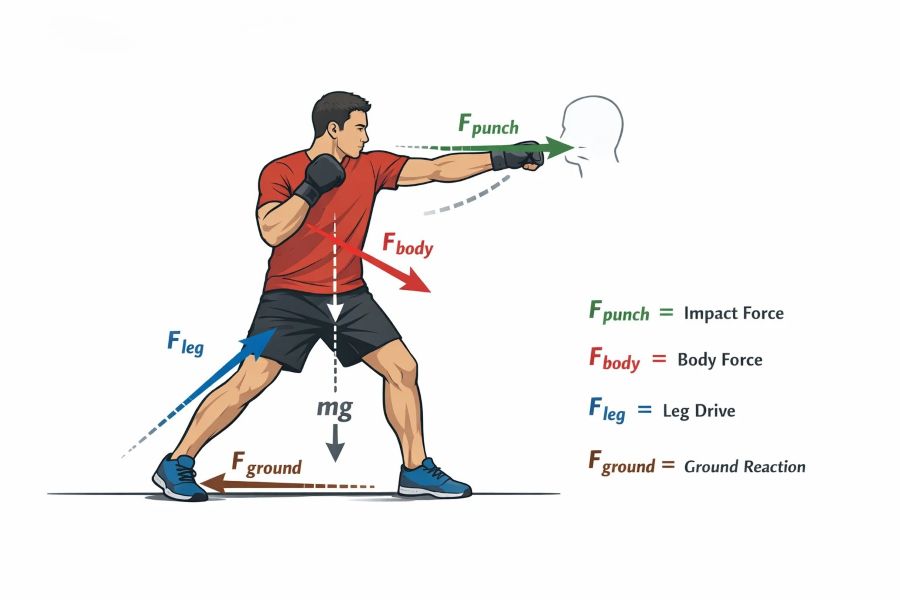
  • Being a black belt is about the integration of the art into your life. It’s about having the “reset effect”—the ability to maintain technical excellence even under pressure. It’s about understanding the kinetic chain of a strike so deeply that your body reacts with precision without conscious thought.

As we often say, for many, the black belt is a finish line. For us, it is the new starting point. It marks the moment a student has finally learned how to learn, graduating from the craft to the mastery of the art.

Why we are careful

This is why we are incredibly careful before awarding a black belt. We frequently see practitioners join us from other clubs with years of experience but lacking the absolute basics—compromised stances, clumsy footwork, or a lack of torque in their strikes. We often have to strip their skills back to zero to unlearn those bad habits.

We refuse to award a rank just to keep a student happy or to maintain numbers. To do so would be a disservice to the student and a betrayal of the standards our senior members have worked so hard to achieve. At CARISMA, we don’t just “collect” members; we nurture martial artists. When you finally wrap that black belt around your waist here, you won’t just be wearing a piece of equipment—you will be embodying a standard of excellence that is recognized by every instructor and peer in the hall. You will have earned it, and more importantly, you will be it.


Beyond the surface: The CARISMA approach to mastering striking mechanics

In the world of martial arts and combat sports, there is a distinct difference between merely being shown a move and truly being taught a technique. In many gyms, instruction amounts to little more than a coach demonstrating a strike and expecting students to mimic the motion. At CARISMA, our philosophy is fundamentally different.

We don’t just show techniques; we dissect them. We believe that true progression comes from deep understanding, which is why we explain every movement in meticulous detail, breaking each technique down into three critical phases: the starting point, the execution, and the ending position.

The anatomy of a technique

A strike is not a single, isolated action; it is a complete process.

  • The starting point: We start from the ground up, ensuring a solid foundation. If your initial stance is compromised, the rest of the technique will fail.
  • The execution: This is the journey of the strike. We explain the exact mechanics required to move from point A to point B safely and efficiently.
  • The ending position: Often the most overlooked aspect of striking, the ending position dictates your defence and your readiness for the next move. A technique is not over until you are back in a safe, balanced guard.

At CARISMA, we do not accept “close enough” or random interpretations of our techniques. By standardizing high-quality mechanics and demanding attention to detail, we foster an environment that supports strong, continuous technical improvement for every single member.

The illusion of experience

Our dedication to the fundamentals becomes glaringly obvious when we welcome members who have previously trained at other clubs. It is not uncommon for individuals to join CARISMA claiming to have two or more years of striking experience under their belts. Yet, when they step onto the mats, we are often astonished by how poorly they have been taught the absolute basics.

We regularly encounter “experienced” practitioners burdened with ingrained bad habits. They often step in with a compromised stance, clumsy footwork, and a complete lack of understanding regarding how to generate power and torque through proper hip and shoulder rotation. Somewhere along their martial arts journey, their previous instructors skipped the essential building blocks in a rush to teach them flashy—but ultimately hollow—combinations.

Striking is a kinetic chain. Without a proper stance, you have no balance. Without efficient footwork, you cannot control distance. Without hip and shoulder rotation, your strikes will always lack true power.

Rebuilding the foundation

At CARISMA, our mission is to fix these gaps. We are dedicated to helping our members genuinely learn and progress, rather than letting them flounder with poor mechanics. Sometimes, this means stripping a practitioner’s skills all the way back to zero to unlearn years of bad habits.

While it requires patience to focus so intensely on the basics, the payoff is immense. By insisting on technical excellence from the starting point to the ending position, we ensure that our members don’t just learn how to hit—they learn the art, science, and mechanics of striking.

Whether you are stepping into a martial arts gym for the very first time or you are looking to correct the bad habits you picked up elsewhere, CARISMA provides the detailed, dedicated coaching necessary to help you realize your full potential.

Our kind of members: the layered journey from white to black belt at CARISMA

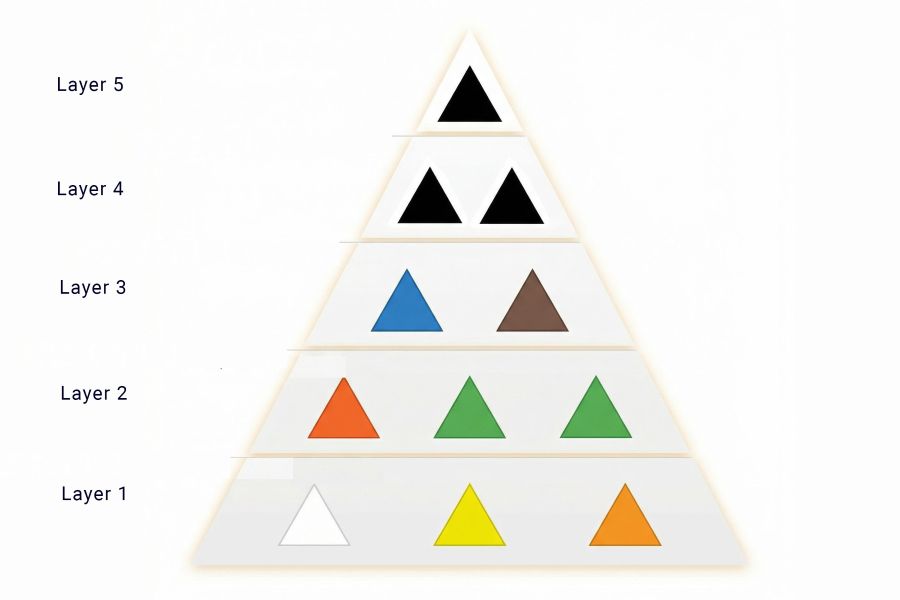
At CARISMA, we don’t just teach kickboxing; we live it. Our passion, at least the one of the keen members and instructors, lies in the grit, the technique, and the personal evolution that comes from stepping into our training hall. We are an open door for anyone—regardless of where they start—who is ready to explore their potential and reap the physical and mental rewards of martial arts. However, we don’t just “collect” members. We nurture martial artists. We view our community through five distinct layers of progression, reflecting a member’s rank, commitment, and the sharpening of their character.

Layer 1: the foundation (White, Yellow, and Orange)

Every journey begins with the first step, in this case, with the courage to be a beginner. In this initial stage, we look for consistency:

  • Expectation: training 2–3 times out of our 4 weekly classes.
  • Focus: building the habit. This is where you learn the language of kickboxing and start conditioning your body for what’s to come.

As people are training consistently the instructors start noticing some people sticking out from the crowd; they attend regularly, they quickly become known faces. Some of them turn up early and trying to practice and apply techniques which are not working for them, until they do.

Layer 2: the transformation (Orange Second, Green and Green Second Belts)

For those who are committed enough to last for about 1 year of steady sweat, the “newbie” shell starts to crack. We expect to see a visible shift in their physical capabilities:

  • Physicality: fitness, strength, endurance and flexibility starts to be noticeably higher.
  • Technicality: punches are crisper, kicks are faster, guard is constantly protecting and movements are more intentional. Even on a gentle sparring they are no longer as easy to hit with basic punches and kicks.
  • Dedication: this is where we see an “increased dedication”—the realization that martial arts isn’t just a hobby, but a discipline and more of a weekly habit.

Here we notice a small number of members who become keener and keener; they get involved in sparring and try their first fight, usually light contact.

Layer 3: the ascent (Blue and Brown Belts)

This is the “extra mile” phase. By the time they reach Blue Belt, the Black Belt is no longer a distant dream—it’s a visible point on the horizon:

  • Blue Belt: we notice members pushing beyond the standard curriculum. Coordination becomes second nature, and sparring moves from “surviving” to “competing competently.”
  • Brown Belt: this is the penultimate step. At this stage, we want members who are hungry for the graduation. They aren’t just practicing; they are preparing to represent the club at the highest student level.

Some exceptional individuals, can be selected to become assistant instructors and offered to get involved in helping out.

Layer 4: the new beginning (Black Belt)

For many, the Black Belt is seen as the finish line. At CARISMA, we see it as the new starting point. “From White to Black Belt takes roughly four years of intense, dedicated training. But once that belt is tied, the real journey begins.” This is where the dedicated martial artist truly begins to shine. The technique is ingrained, the fitness is peak, and the mind is disciplined. You’ve graduated from learning the craft to mastering the art.

Layer 5: instructors and coaches

Many of the members who became black belt at CARISMA over the years had a position as instructors.  Some instructors achieved this position without yet wearing a black belt. At CARISMA we select very carefully who are those dedicated and technically sound members who have the knowledge and personality to run classes. We expect a very high level of dedication and consistency to training and fitness to ensure all instructors can show and do every technique we practice as well as being able to teach and coach any member around techniques, blocks, guard, footwork and sparring methodologies.

The CARISMA timeline

While everyone moves at their own pace, here is a general look at the commitment required:

Milestone Timeframe Primary Focus
White to Orange Months 1–12 Consistency & Core Basics
Green Belts Year 1–2 Fitness, Speed & Strength
Blue to Brown Year 2–4 Sparring, Coordination & Dedication
Black Belt 4+ Years Mastery & Advanced Practice

Whether you are here to get fit or to eventually wear the Black Belt, we are ready to help you push your limits. The question is: are you ready to find your layer?

From resilience and discipline to inner power: how martial arts shape the next generations

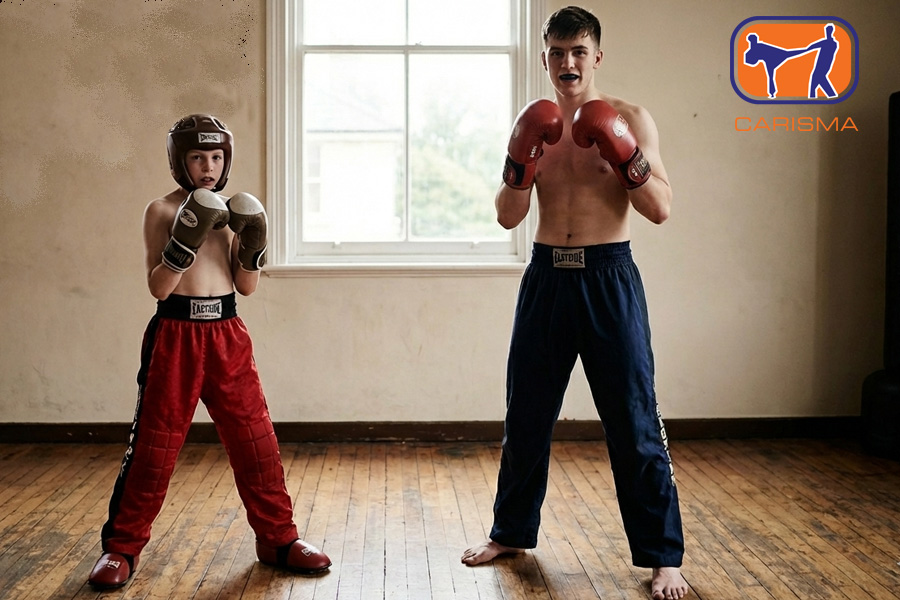
A few weeks ago, I received a call that reminded me exactly why we do what we do at CARISMA. It was from a father in Cambridge whose 10-year-old son had recently been bullied and, unfortunately, physically assaulted, however slightly. The father, having practiced martial arts in his own youth, knew the transformative power of the dojo. After researching several clubs in the area, he reached out to me because of the philosophy he saw reflected on our website. He wasn’t just looking for someone to teach his son how to throw a punch or a kick; he was looking for a place where his son could rebuild his world and pave the way for self confidence.

The post-pandemic shift

While we haven’t historically been a “children’s club,” the last few years have seen a fascinating shift. Since the end of the COVID-19 pandemic, we have seen a flourishing of 12-to-15-year-olds—both boys and girls—joining our classes. Watching these young people evolve is one of the most rewarding aspects of coaching. In a world that felt very small and uncertain for a long time, these teens are finding their space. We see them grow:

  • Physically: developing the coordination, strength, and “explosive power” of a true martial artist.
  • Emotionally: moving from the hesitancy of early adolescence to a grounded, calm sense of self.

The pillar of confidence, discipline, and respect

At CARISMA, we don’t sugarcoat the training. We train hard, however within the limits and aspirations of each individual. But it is through that “hard” work that the most beautiful transformations happen. Young people today are often over-stimulated but under-challenged. When they step into our gym, they learn discipline and resilience—the ability to do what is required even when they are tired. They learn respect—for their partners, their instructors, and, most importantly, themselves. “Training hard helps these young people build a core of confidence that no bully can shake.”

The Paradox of Self-Defence

People often ask if we teach “self-defence.” My answer is often a bit different than what they expect. True self-defence isn’t just a set of techniques; it is a state of mind. It is mostly learnt by being so confident in your ability to fight that you no longer feel the need to prove anything to anyone. However, if you ever need to protect yourself bit hitting someone your strike will be powerful, efficient and hitting where it does the most damage. The best thing is that when a young person knows they can defend themselves, the “need” to demonstrate it vanishes. They carry themselves differently. Their shoulders are back, their eyes are up, and that internal security acts as a far more effective shield than any physical move ever could. They aren’t looking for a fight; they are simply no longer afraid of one.

Building the future

It is a privilege to watch these teenagers develop into powerful martial artists and, more importantly, resilient young adults. Whether it’s a 10-year-old regaining his footing or a 15-year-old finding her strength, we are here to provide the tools for that journey.