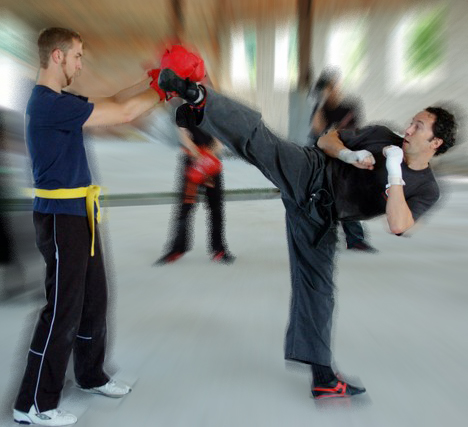

I will define proper alignment, for the purpose of this post, as the correct alignment of limbs and other body parts so that all vectors of the forces involved in a particular movement or techniques are correctly aligned in order to produce the best performance. For simplicity we can call internal alignment the alignment of your own body and external alignmentwhen we refer to the alignment of your body compared to the position of your opponent. Bruce Lee used for the same purpose the definition of winner’s position in his “Tao of June Kune Do”. I will explain in this post the importance of proper internal and external alignment for maximum results, applied to the front stance.
For the majority of people training martial arts it should be pretty obvious the correct internal alignment when preparing for or performing a technique. When training traditional martial arts like Karate, Judo or Aikido a lot of emphasis is paid to the external alignment as well as the internal one. Wing Chun has even a form based on the wooden dummy where proper alignment of techniques can be trained and improved by the continuous feed back that the dummy actually offers.
When training contact sports like kickboxing or boxing the application of proper internal alignment offers a good and stable position that is optimum for attacking and defending. The effectiveness of external alignment is easily measurable when testing the actual power that can be exercised onto a target. I prepared some simple pictures below that explain my thinking from a front stance that applies to boxing, kickboxing and many other fighting styles. In all of the pictures the shapes of the feet show the correct angle to be standing (with small personalised variations) and the cross indicates where the centre of gravity should be falling, aligned to the central line of the person.
Correct alignment
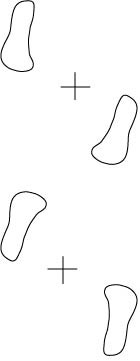 When two opponents are aligned as in this picture all punches will work correctly as well as all kicks with the rear leg (right, in this case). In this case the one person’s right foot is in line with the other person’s left foot and their central lines are in front of each other. We should remember that all straight strikes (jab, cross, front kick, side kick) should be aimed at the central line of the opponent (with small variations) while the round kick will go across in a circular motion that naturally tend to align the right foot to the line of the left on while hitting the opponent in the process.
Misaligned on the left
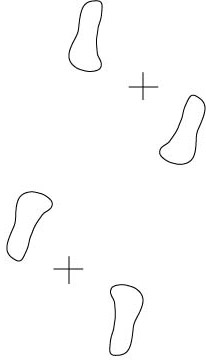 This is when the right feet of both opponents are nearly or completely aligned. When misaligned on the left you might have the illusion that straight strikes such as front and side kicks with the rear leg come easier but, in reality, your all structure is weaker and most punches will not work properly. The round kick with rear leg will have to travel a shorter distance to hit the target but it will end up weaker than when properly aligned.
Misaligned on the right
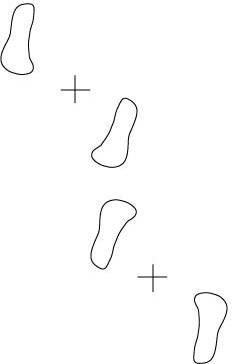 I find this to be the most common form of misalignment, particularly among beginners. Some people instead of trying mirroring the opponent’s position tend to align their left shoulders when facing an opponent. In this case the left feet of both opponents are nearly or completely aligned. All techniques coming from the rear part of the body will be very weak because they will never reach the optimum alignment of the body they have been designed for. Techniques with the front hand will also be weaker than when correctly aligned.
Misaligned at an angle
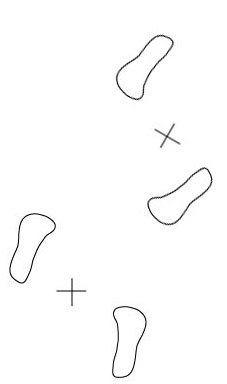 When one of the opponents stands at a funny angle the whole concept of alignment will cease to work and most techniques will simply have to be performed accepting reduced performance or by trying to realign with proper foot work.
All examples seen above could be obviously mirrored when people are standing with the right foot in front.
Conclusion
These examples of alignment and misalignments should be considered individually, taking into account the dynamic aspect of a fighting sport or a martial art. Positions of two opponents could be changing several times within a few seconds and it might be difficult to seize the right instant when everything is next to perfect. In my experience the most essential thing is to train the positions and the alignment statically as part of individual techniques or combinations and then check them during sparring to ensure that they work as expected.