

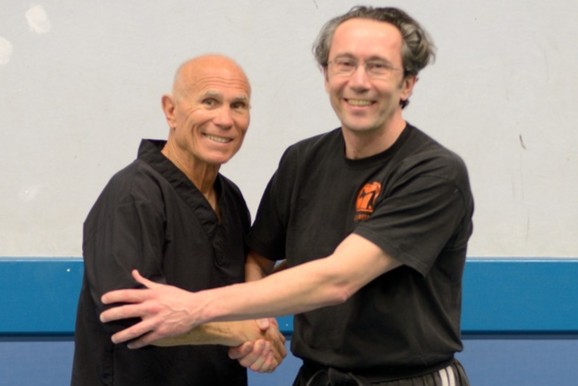
Image Courtesy and Copyright Duncan Grisby
In the modern era of combat sports, we’ve witnessed the rise of the “training camp”—an intense, multi-week sprint designed to peak an athlete for a specific date. While this works for the elite 1% of professional fighters, it has birthed a “gig culture” in local gyms and university clubs. This shift away from consistent, lifelong practice toward a “project-based” approach isn’t just a change in training style; it’s a fundamental misunderstanding of what it means to be a martial artist.
The “old school” blueprint: training for longevity
The “old school” philosophy isn’t about being soft; it’s about being sustainable. The goal is to train consistently and hard, but always with enough reserve that you aren’t “broken.” Take, for example, the legendary Bill “Superfoot” Wallace. Even in his 80s, Wallace remains incredibly fit, flexible, and capable of demonstrating while teaching, which he still does weekly. He didn’t achieve this through sporadic bursts of violence followed by months of sedentary living. He achieved it through a steady, rhythmic relationship with his craft. Your goal should be “ready to go” at any moment, rather than spending six weeks “getting ready” to start training.
The Cambridge trap: cramming for the canvas
A fascinating case study in this “gig culture” can be found in high-pressure academic environments, such as the University of Cambridge Kickboxing team. Students there are masters of the “academic sprint”—absorbing thousands of pages of complex information in a short window to pass gruelling exams. Naturally, many try to apply this same logic to fighting:
- The approach: treat the fight like a final exam.
- The method: train at 200% intensity for a few weeks, neglecting rest and foundational skill-building.
- The results: a crash-and-burn cycle, inadequacy and defeat more often than not.
The fatal flaw here is that intellectual absorption and physical integration are two different beasts. While you can “cram” facts into your brain, you cannot “cram” neuromuscular pathways and emotional regulation into your body. Under the heavy emotional overload of a real fight, the “crammed” knowledge evaporates, leaving the fighter with no foundation to fall back on.
The “gig culture” vs. the body
In your twenties, the body is a forgiving machine. You can abuse it with brutal recoveries, survive weeks of inactivity, and then jump back into a high-intensity camp without immediate catastrophe. However, this is a loan with a high interest rate.
The risks of the sprint mentality:
- The injury cycle: tendons and ligaments don’t adapt as fast as muscles. “Gig” training often leads to acute injuries because the body isn’t conditioned for the sudden spike in load.
- Early retirement: when you treat every fight as a “survival project” rather than a “routine test” the psychological and physical burnout eventually outweighs the passion for the sport.
- Diminishing returns: without consistent training, you spend the first half of every “camp” just regaining the fitness you lost during your time off.
Being vs. doing:
The fundamental difference lies in your identity.
- The gig fighter is someone who does kickboxing when a date is set.
- The martial artist is someone who is a practitioner regardless of the calendar.
If you want to be a martial artist, you have to avoid the temptation of the “gig” routine. Consistency allows for a deeper level of skill acquisition—where techniques become second nature rather than something you have to remember.
Tips for Sustainable Training:
- Keep the “low” high: your baseline fitness during “off-times” should be high enough that a fight notice is a minor adjustment, not a lifestyle overhaul.
- Listen to the redlines: train hard enough to progress, but never so hard that you compromise the next day’s session.
- Focus on technical fluency: use your consistent time to develop the “quiet” skills—timing, breathing, and distance—that can’t be learned in a three-week blitz.
The bottom line: there is no doubt that training camps have their importance and they help you to focus, while training with like minded individuals. However if you want to be kicking as high and as fast as Bill Wallace when you’re eighty, you have to stop treating your training like a series of one-night stands. Marry the process.
