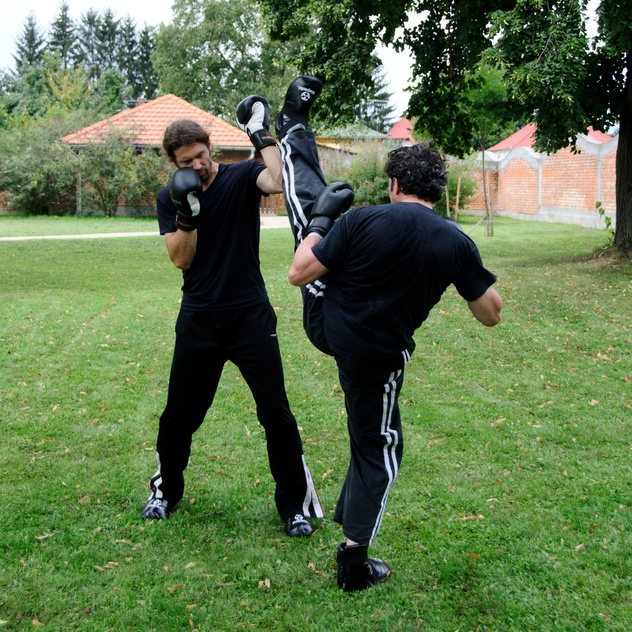

 Let’s be real: stepping into a ring for three rounds of two minutes sounds like a short commitment until someone is actively trying to take your head off. Full contact fighting isn’t just a sport; it’s a high-stakes puzzle solved under extreme physical and mental duress. We don’t start from zero. We assume our athletes are already “keen” kickboxers with a solid foundation. Our job is to take that raw skill and forge it into a weapon that can withstand the extreme pressure of a real fight. Here is how we bridge the gap between “decent” and “proficiently safe”.
The first step, a few words of caution
My conversation with any aspiring full contact fighter is to ensure they understand these basic concepts:
- This is not going to be a walk in the park or even a marathon run where there is one winner and many participants. It will be you and your opponent in the ring and one of the two will be a winner
- You are entering a sports competition where your opponent is trained and authorised to hurt you, within the regulations which are enforced by a referee
- Our aim is to train you to win but, if you don’t make it, you will lose in a way that it will minimise your damages
Refining the arsenal: efficiency over flash
In a full-contact environment, every movement must have a purpose. We strip away the “fluff” and focus on the mechanics of single techniques. If a jab isn’t snapping or a round kick isn’t turning the hip over correctly, it’s wasted energy.
- Maximum damage: we tweak body mechanics to ensure every strike carries the weight of the entire body, not just the limb
- The “iron shield” guard: offense is great, but if your chin is in the air, the fight ends early. We drill “active defence,” ensuring that even while attacking, the opposite hand is glued to the jaw and the shoulders are tucked
The science of the combination
Throwing a single punch is easy. Throwing a four-strike combination that leaves you protected and ready to counter is an art form. We train our fighters to deliver sequences that flow naturally and exploit the opponent’s defensive reactions. We consider these different aspects of the action:
- Flow: Eliminating the “reset” pause between a punch and a kick during a combination to improve speed of any combination
- Angle cutting: moving off the centreline during the combination and keeping a tight guard at all times to avoid counter attacks
- Damage density: ensuring that every punch or kick in a combination delivers damage the final (exit) strike is the most powerful
Power, meet volume
It’s one thing to hit a heavy bag hard once. It’s another to maintain that “knockout power” in the final thirty seconds of the third round when your lungs are screaming.
We push our athletes through high intensity interval drills that mimic the rhythm of a fight: explosive bursts followed by active recovery. The goal is simple: be able to hit harder than ever before and keep doing it for as long as the referee allows.
The mental fortress: concentration under fire
The biggest challenge in full contact isn’t the pain—it’s the panic. When fatigue sets in, the first thing to go is the mind. You lose your “eyes,” you stop seeing the openings, and you forget your guard. We use pressure testing to build mental resilience. By the time our fighters step into the ring, they have already been in deep water during training. They’ve learned to keep their focus sharp and their breathing steady, even when the pressure is beyond what most people expect.
The payoff: why we do it
Training for full contact is, frankly, exhausting and occasionally painful. But it pays dividends that few other experiences can match.
- Minimized damage: proper preparation is the best insurance policy against injury
- Unshakeable assurance: knowing you have the “gas in the tank” and the skills to handle a hostile opponent provides a level of self-confidence that carries over into every aspect of life
- The satisfaction of the grind: there is a unique pride in knowing you didn’t take the easy road.